24 Jul 2026
The Hidden Infrastructure Behind Browser-Based Multiplayer Tournaments in Remote Regions

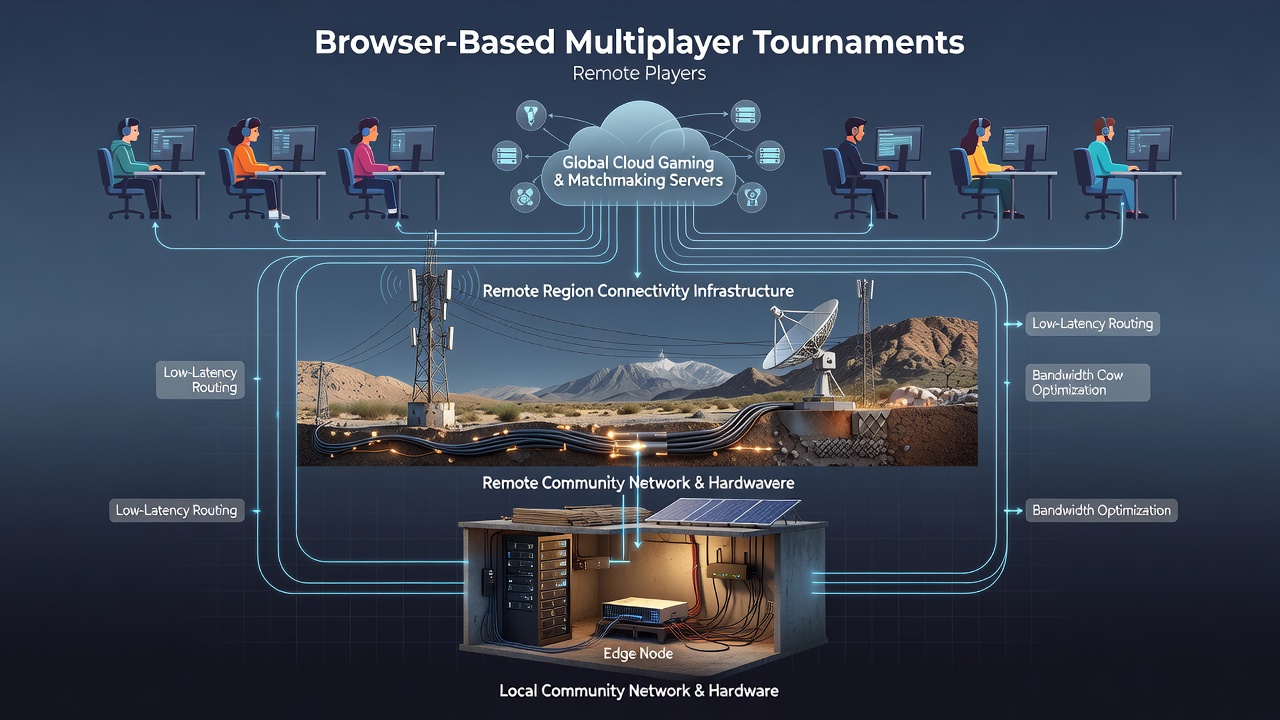
Browser-based multiplayer tournaments have expanded into remote regions where traditional connectivity remains unreliable, and the supporting systems often stay out of view while players compete in real time. These events rely on combinations of satellite networks, edge computing nodes, and content delivery networks that route traffic through the nearest available points of presence. In July 2026 several such tournaments took place across parts of northern Canada and rural Australia, and organizers coordinated with local telecom providers to maintain stable sessions despite variable bandwidth.
Data from the International Telecommunication Union shows that satellite backhaul now covers increasing percentages of sparsely populated areas, which allows WebRTC sessions to stay synchronized across hundreds of participants. Researchers at the University of Calgary have documented how latency spikes drop when traffic shifts to low-earth-orbit constellations instead of older geostationary links, and their findings indicate that average round-trip times can fall below 80 milliseconds in previously underserved zones. Edge servers placed in regional hubs cache game state and reduce the load on distant data centers, which helps maintain consistent frame rates even when local power fluctuates.
Network Architecture in Challenging Environments
Operators deploy micro data centers that run on hybrid power sources including solar arrays and diesel generators, and these facilities host the virtual machines that manage matchmaking and session persistence. When tournaments occur in July 2026, teams in the Australian outback used portable edge nodes connected via Starlink terminals to route player inputs through the closest available relay. Studies published by the GSMA reveal that such setups cut packet loss rates by roughly 40 percent compared with routes that traverse multiple international gateways.
Content delivery networks operate clusters of servers at major internet exchange points, yet in remote regions the same providers install smaller caches inside community centers or school buildings. These caches store static assets such as character models and map files, while dynamic elements travel over dedicated WebSocket channels. Observers note that this division keeps download times short and allows browsers to focus processing power on rendering rather than repeated asset fetches.
Power and Hardware Considerations
Remote tournament sites often depend on battery banks and renewable energy to keep routers and servers online during extended play windows. Engineers design failover systems that switch to backup generators within seconds of a grid outage, and telemetry from these systems feeds into central dashboards monitored by support staff. Figures released by the Canadian Radio-television and Telecommunications Commission indicate that regions with at least 30 percent renewable micro-generation experience fewer session interruptions during peak summer months.
Browser compatibility remains a limiting factor because older devices common in remote communities may lack the latest WebAssembly optimizations. Developers therefore compile fallback code paths that degrade gracefully when hardware acceleration is unavailable, and testing teams run automated checks against representative device inventories collected from partner schools and libraries. Research conducted at the University of Melbourne has shown that these adaptations allow participation rates to stay above 85 percent even on modest laptops.
Security and Data Routing Protocols
Multiplayer sessions transmit player actions and positional data that require encryption and replay protection, and protocols such as DTLS combined with sequence numbers prevent tampering during transit. In remote deployments, operators route sensitive traffic through virtual private networks that terminate at the nearest secure gateway before reaching the central match servers. Reports from the European Union Agency for Cybersecurity highlight that these layered protections reduce the incidence of man-in-the-middle interference without adding measurable latency in satellite-linked environments.
Regional internet registries allocate IPv6 prefixes specifically for community networks, which simplifies traffic engineering and allows organizers to apply quality-of-service rules that prioritize tournament packets over background downloads. When July 2026 events occurred in parts of East Africa, coordinators worked with local regulators to obtain temporary spectrum allocations that supported higher uplink speeds during competition hours.
Conclusion
The systems that enable browser-based multiplayer tournaments in remote regions combine satellite connectivity, distributed edge infrastructure, and adaptive software layers that together overcome geographic and resource constraints. Data gathered during the July 2026 cycle demonstrates measurable improvements in session stability when these components operate in coordination, and continued investment in local power solutions and caching nodes is expected to extend access further. Observers continue to track performance metrics across additional regions to identify patterns that can guide future deployments.